Where on Google Earth #62

With some help from Wikipedia, I found that the image posted by Joe was from a volcanic field in western Sudan. So here comes WoGE #62.


Compared to the Peruvian meanders, this should be easy. Extra points for knowing the story that this place is a good example of — there is a specific journal article I am thinking about.

Schott rule in effect (post time 8:22 pm CST, 10-17-07).

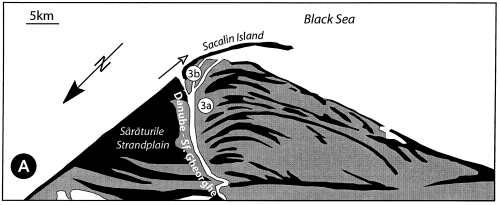
Update: Brian has the answer; here is a bit more detail about this image. It’s the southernmost distributary of the Danube Delta in Romania, called the Sfantu Gheorghe channel. The geometry of the deposits is determined by (1) the river discharge, (2) the wave energy of the Black Sea, and (3) the southward oriented longshore transport. The asymmetry of the lobe is a function of the ratio between the net longshore transport rate at the mouth and river discharge. The longshore currents erode the beach/barrier bars on the northern side of the channel mouth. More details in this paper. This image also comes from Bhattacharya and Giosan (2003):


Black represents sand, gray is predominantly muddy deposits, and the white arrow at the river mouth shows the direction of longshore drift.

The importance of numbers in sedimentary geology

A few years ago, Chris Paola published a paper in Sedimentology on “Quantitative models of sedimentary basin filling”. I was skimming through it today, and found these thoughts about the role and status of quantitative reasoning in sedimentary geology:

…what is needed is researchers who are skilled in the field but at the same time understand what quantitative modelling is about: why and how people make approximations, why approaches to modelling can and must differ, and, above all, what the mathematics in the models mean physically. Just as there is no substitute for experience in learning to work in the field, there is no substitute for experience in developing physical insight. And there is no shortcut: we need researchers who are good at at both traditional, descriptive geology and quantitative geology. For the ‘modal’ sedimentary-geology student, it is not sophisticated computational skills or training in advanced calculus that is lacking, but rather the routine application of basic quantitative reasoning. This means things like estimating scales and rates for key processes, knowing the magnitudes of basic physical properties, and being able to estimate the relative importance of various processes in a particular setting. Understanding scales, rates and relative magnitudes is to quantitative science what recognizing quartz and feldspar is to field geology. Neither requires years of sophisticated training, but both require repetition until they become habitual.

And:

Some 30 years after the initial ‘physics scare’ associated with bedforms and sedimentary structures, a set of basic principles from fluid and sediment mechanics now appears routinely in introductory sedimentology textbooks. Popular items include settling velocity and Stoke’s Law, the Reynolds and Froude numbers, and the basic force balance for steady, uniform channel flow. This material is typically presented somewhere near the beginning of the book and then is largely ignored. (…) There remains a striking contrast between the role of fluid and sediment physics in sedimentary geology and that of thermodynamics in igneous and metamorphic geology. In ‘ig-met’ texts the underlying thermodynamic principles are introduced and then applied repeatedly. Whereas in hard-rock petrology, thermodynamics permeates the discipline, in sedimentary geology, sediment mechanics still seems a little like taking vitamins: it is surely good for you, but most people cannot say exactly why. There are several reasons for this. In current practice, process-based interpretation is often applied in a piecemeal, descriptive way, to no apparent end beyond providing the interpreter with one more adjective. In addition, the quantitative material that is traditionally taught more often not the most important. For instance, a real appreciation of the implications of the sediment-continuity equation as the governing relation for physical sedimentation is far more useful than the details of sediment-transport formulae or even the definition of the Reynolds number.

Although I still have a lot to learn myself, I couldn’t agree more.

ps. Check out what Lord Kelvin had to say about the importance of numbers in science.

My blogospheric Multiple Personality Disorder is over

… well, at least for my readers. From now on, ‘Hindered Settling’ will only feature blog posts in English (or Hunglish, a hungarianized version of it), but those of you (all five of you 🙂 ) who from time to time had to think “ok, one of those posts in some weird Eastern European language again” will not have to do so any more (apart from the last one above). My Hungarian ego has decided to move to WordPress. If you are interested in weird Eastern European languages, you can check it out here.

Blast from the past: images from Peru

After several years of thinking and saying that I should do something about my old color slides that are only gathering dust in a corner, I finally did it: I sent a few hundred old pictures to Scancafe to have them scanned. It takes quite a bit of time to get the scans back, but it’s worth it. The quality is better than I expected, and even if I had somehow access to the right kind of scanner (the average scanner just won’t do it), I would have spent many hours doing this.

So I got the DVD today from Scancafe, and I keep looking at these pictures from Peru, taken during five weeks of field work in the Talara Basin, I think seven years ago, followed by a week of vacation in Cusco and Machu Picchu. They are either very good, or I had too much of a good time.

In either case, I’ve got to go back.


Where on (Google) Earth #57

I figured out that the Google Earth image posted by Kim was cut by a famous fault, so I have a chance to post the next installment of Where on (Google) Earth. I don’t think this is easy – it is certainly not a famous geologic locality, and I know it would be tough for me. But I have been interested in erosional meanders for some time, so here you go. North is up.

Update — hint: it is in a forearc basin.

Changing one’s mind is not a sign of weakness

Seed Magazine’s second annual science writing contest is over now, and the essays of the first and second prize winners are available online. Here is something worth noting in the piece by Thomas W. Martin:

The goal of science is to find those ideas that can withstand the long and hard barrage of evidence-based argument. That lesson must be experienced anew by the members of each generation, irrespective of their careers. Mastery of scientific concepts and theories is a necessary starting point, but it serves only as a prerequisite to joining the never-ending dialogue. Students must learn first-hand how to both imaginatively create new hypotheses and to dispassionately critique them. Many commentators have rightly implored us to make certain that young people encounter the “thrill” of discovery. While this is undeniably desirable, it is arguably even more crucial that they experience the agony (if only on a modest scale) of having a pet hypothesis demolished by facts.

Several current presidential candidates have insisted that they oppose the scientific account of earth’s natural history as a matter of principle. In the present cultural climate, altering one’s beliefs in response to anything (facts included) is considered a sign of weakness. Students must be convinced that changing one’s mind in light of the evidence is not weakness: Changing one’s mind is the essence of intellectual growth.

New images from Mars: the idea of very recent watery flows is evaporating

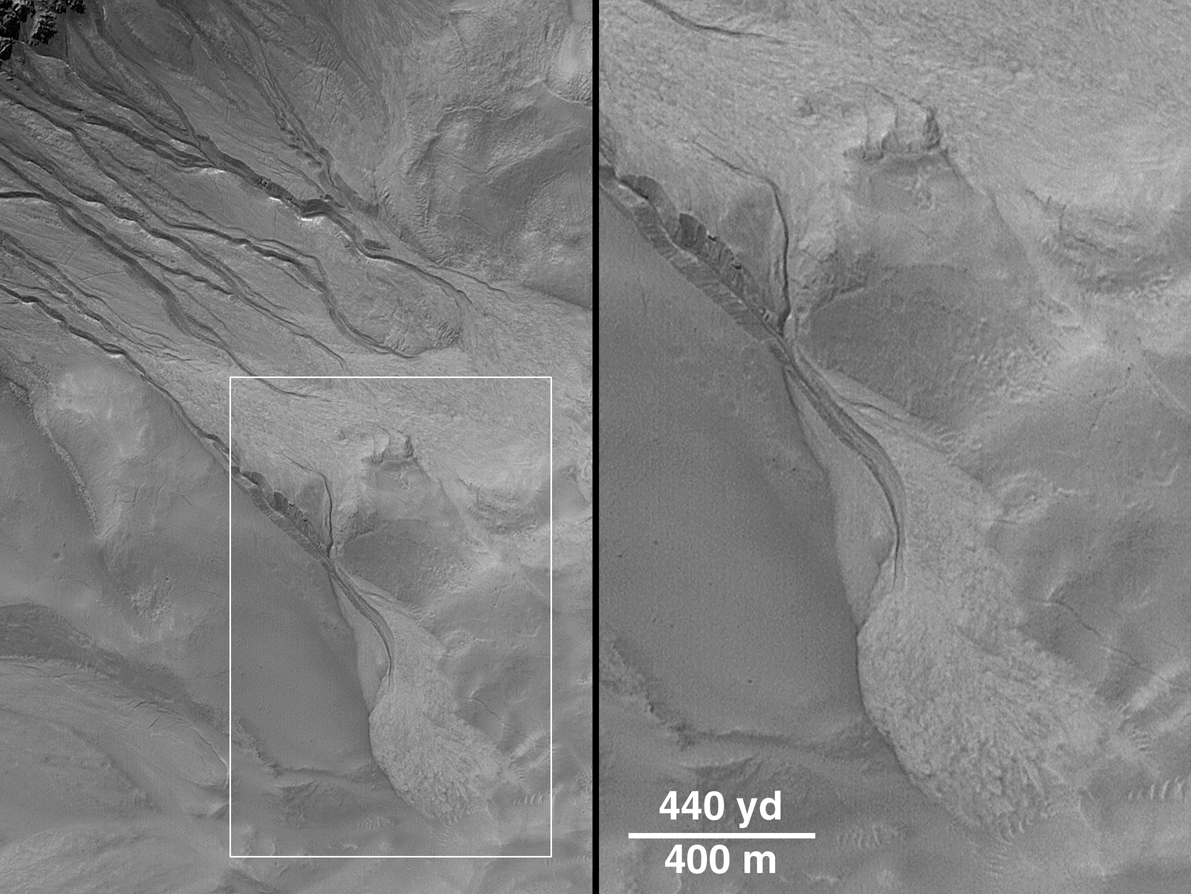
A few months ago I commented on the fact that, despite numerous scientific and media reports, the existence of recent watery flows on Mars is far from being obvious or proven. While there are many rock formations exposed at the planet’s surface that clearly suggest flowing water some time in the ancient past – for example, the delta near Holden Crater -, many of the young gullies and debris fans have no unequivocal signatures of recent watery flows.

The high-resolution images with the relatively recent gullies were released in 2000, and a paper was published in Science about how these features suggest the presence of liquid water on the Martian surface. Last year, this idea seemed to get new support, in the form of some images taken in 2005 were showing sedimentary activity on crater walls, when compared to images shot a few years earlier.

(image from Malin Space Science Systems)
The problem is, as I said, that nothing in these images suggest unequivocally the presence of water. Geologist Allan Treiman published a paper in 2003 stating this, but at that time his views were representing the minority viewpoint. Needless to say, the news reports got rid of the last remaining uncertainties and doubts in the story, and presented it as if it was 100% sure that liquid water exists today on Mars.

Now there is new evidence that the recent watery flows are not so watery after all. Rather, they are probably dust avalanches, dry flows similar to the ones that occur on windblown dunes here on Earth. Such flows can only form on steep slopes, that are close to the angle of repose. The problem, of course, is complicated – as many problems in science are – and there is no simple answer. For example, in the image shown above, you can see a fan that has been reincised after its deposition by its own feeding channel, so that the latest active deposition occurs further downdip. Such erosional valleys are probably associated with turbulent flow, suggesting that these fans were probably deposited by watery flows. More recent images (see below) also show details of erosional channels that are suggestive of watery flows. Unless the dust avalanches were highly turbulent density flows, similar to some snow avalanches, and they were even able to cut channels. Again, I think there is no easy and obvious answer.

photo from NASA’s Planetary Photojournal
In any case, there are two new papers in Science on this subject, check them out if you have online access (I don’t 😦 ).

Flame structures


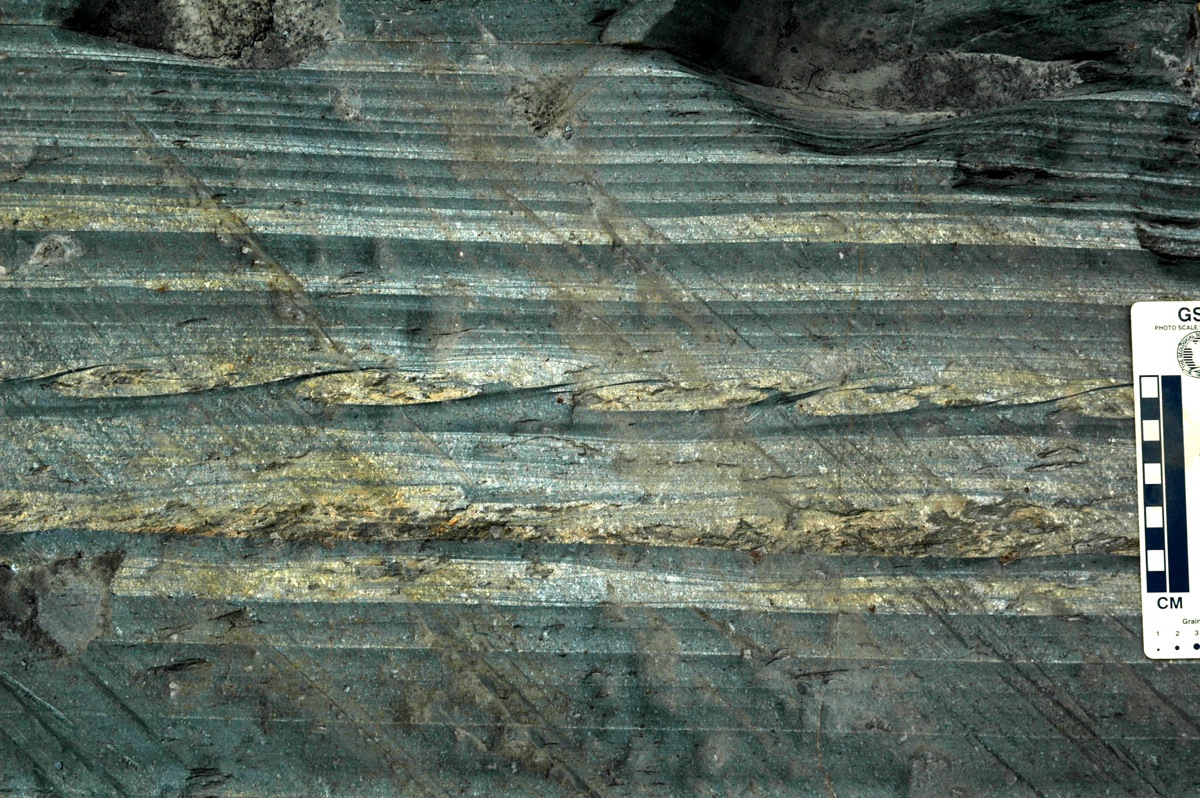
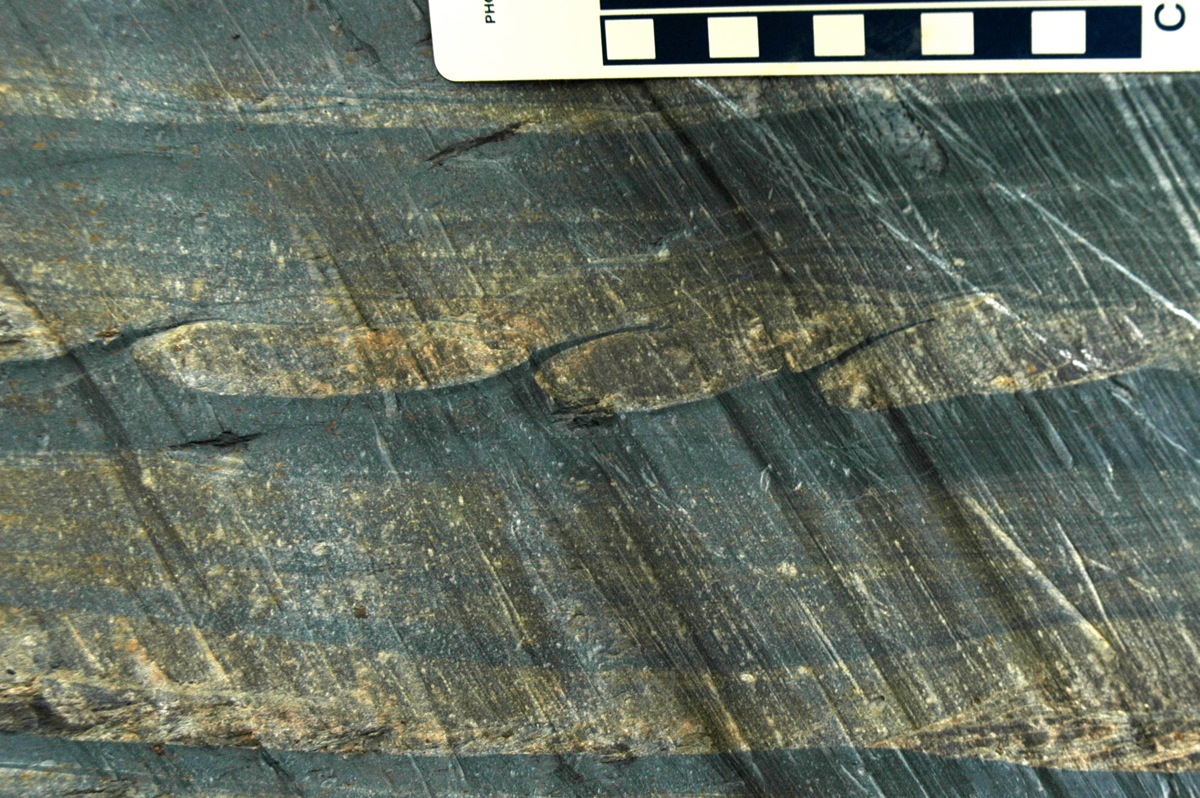
Flame structures are sedimentary structures that usually consist of upward-pointing flame-shaped finer-grained sediment tongues that protrude into coarser sediment (like sand). Almost invariably, the ‘flames’ are inclined in a downslope direction (in a paleogeographic sense, of course) — like in these two images from the Precambrian Windermere Group in the Canadian Caribou Mountains.


Flame structures are often interpreted as load structures: the overall higher-density sand sinks into the lower-density underlying shale. That would put flame structures into the category of Rayleigh-Taylor instabilities, which result from density inversion. In geology, one of the most important types of Rayleigh-Taylor instability is related to salt: if buried deep enough, the density of the compacting overlying sediment exceeds the density of salt, and the latter starts flowing upward, giving rise to salt diapirs. Salt diapirs often have mushroom shapes, typical of Rayleigh-Taylor instabilities.

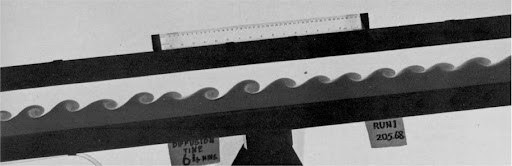
The shapes of the flame structures above actually remind me more of the Kelvin-Helmholtz instability, which is related to shear (that is, different velocities) across a fluid interface, and can occur even if the densities are not inverted. K-H instabilities in the atmosphere can result in elegant clouds. K-H billows are common at the tops of turbidity currents, due to the shear between the static water column above and the moving sediment-laden current below. There is no reason why the instability could not occur at the base of the current as well, if the underlying sediment is still fluid enough, and the current itself is not too erosive.

Here is the classic picture of K-H billows at the top of a density current, from Van Dyke’s Album of Fluid Motion.


Clastic Detritus has more on flame structures.

Peyto Lake / Caldron Lake trail

[This is my last post about Peyto Lake, I promise.]

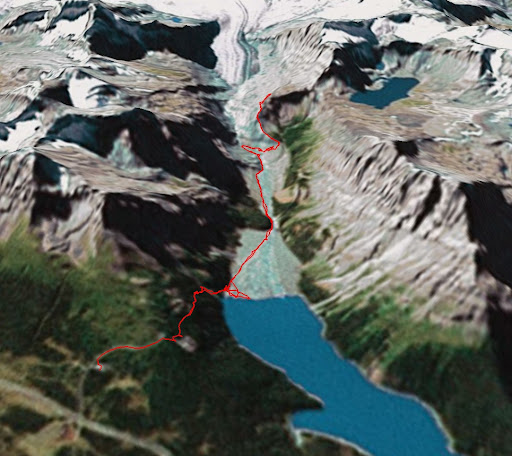
Here is a KMZ (= Google Earth) file for the trail that leads from the Peyto Lake viewing platform to Caldron Lake. It corresponds to the red line in the screenshot below. It is obvious that we never got to Caldron Lake…


You can also see some of the photos in Google Earth, if you download and open this file.