Meme of Four

Well, Hindered Settling got a bit too settled lately, so it’s time to shake it up. Brian’s tagging is a good excuse to do that, even though some of this may be too much detail. Here it goes, anyway.

4 jobs you’ve had:
1. teaching assistant (yes, it was a full time job in Romania)
2. does graduate work count as a job?
3. does serving in the Romanian Army count as a job? (probably no)
4. petroleum geologist

4 movies you could watch over & over:
1. Sideways
2. The Lives of Others
3. Annie Hall
4. Black Cat, White Cat

4 places you’ve lived:
1. Sfantu Gheorghe, Romania
2. Cluj, Romania (both #1 and 2 are in Transylvania as well)
3. Portola Valley, California (quite a change)
4. Houston, Texas (quite a change, again)

4 TV shows you love to watch:
1. Seinfeld
2. Extras
3. The Daily Show
4. Kitchen Nightmares (I admit it, too)

4 places you’ve been on holiday vacation:
1. Tuscany
2. Canadian Rockies
3. Paris
4. Yellowstone

4 authors you love to read:
1. Richard Dawkins
2. Steven Pinker
3. Bill Bryson
4. Jared Diamond

4 websites you visit daily:
1. Scienceblogs
2. New York Times
3. Macworld
4. RichardDawkins.net

4 of your favorite foods:
1. Avocado (I hated it a few months ago)
2. Pasta
3. Stuffed cabbage (Transylvanian style)
4. Cheese, mainly Italian

4 places you’d rather be:
1. skiing anywhere
2. in the Vargyas Valley (in Transylvania)
3. San Francisco
4. tasting wine, anywhere

4 lucky people to tag:
no tagging, but – of course – feel free to get and spread the meme

Where on Google Earth #62

With some help from Wikipedia, I found that the image posted by Joe was from a volcanic field in western Sudan. So here comes WoGE #62.


Compared to the Peruvian meanders, this should be easy. Extra points for knowing the story that this place is a good example of — there is a specific journal article I am thinking about.

Schott rule in effect (post time 8:22 pm CST, 10-17-07).

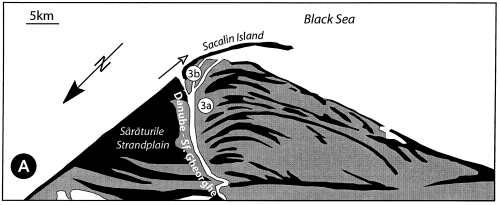
Update: Brian has the answer; here is a bit more detail about this image. It’s the southernmost distributary of the Danube Delta in Romania, called the Sfantu Gheorghe channel. The geometry of the deposits is determined by (1) the river discharge, (2) the wave energy of the Black Sea, and (3) the southward oriented longshore transport. The asymmetry of the lobe is a function of the ratio between the net longshore transport rate at the mouth and river discharge. The longshore currents erode the beach/barrier bars on the northern side of the channel mouth. More details in this paper. This image also comes from Bhattacharya and Giosan (2003):


Black represents sand, gray is predominantly muddy deposits, and the white arrow at the river mouth shows the direction of longshore drift.

The importance of numbers in sedimentary geology

A few years ago, Chris Paola published a paper in Sedimentology on “Quantitative models of sedimentary basin filling”. I was skimming through it today, and found these thoughts about the role and status of quantitative reasoning in sedimentary geology:

…what is needed is researchers who are skilled in the field but at the same time understand what quantitative modelling is about: why and how people make approximations, why approaches to modelling can and must differ, and, above all, what the mathematics in the models mean physically. Just as there is no substitute for experience in learning to work in the field, there is no substitute for experience in developing physical insight. And there is no shortcut: we need researchers who are good at at both traditional, descriptive geology and quantitative geology. For the ‘modal’ sedimentary-geology student, it is not sophisticated computational skills or training in advanced calculus that is lacking, but rather the routine application of basic quantitative reasoning. This means things like estimating scales and rates for key processes, knowing the magnitudes of basic physical properties, and being able to estimate the relative importance of various processes in a particular setting. Understanding scales, rates and relative magnitudes is to quantitative science what recognizing quartz and feldspar is to field geology. Neither requires years of sophisticated training, but both require repetition until they become habitual.

And:

Some 30 years after the initial ‘physics scare’ associated with bedforms and sedimentary structures, a set of basic principles from fluid and sediment mechanics now appears routinely in introductory sedimentology textbooks. Popular items include settling velocity and Stoke’s Law, the Reynolds and Froude numbers, and the basic force balance for steady, uniform channel flow. This material is typically presented somewhere near the beginning of the book and then is largely ignored. (…) There remains a striking contrast between the role of fluid and sediment physics in sedimentary geology and that of thermodynamics in igneous and metamorphic geology. In ‘ig-met’ texts the underlying thermodynamic principles are introduced and then applied repeatedly. Whereas in hard-rock petrology, thermodynamics permeates the discipline, in sedimentary geology, sediment mechanics still seems a little like taking vitamins: it is surely good for you, but most people cannot say exactly why. There are several reasons for this. In current practice, process-based interpretation is often applied in a piecemeal, descriptive way, to no apparent end beyond providing the interpreter with one more adjective. In addition, the quantitative material that is traditionally taught more often not the most important. For instance, a real appreciation of the implications of the sediment-continuity equation as the governing relation for physical sedimentation is far more useful than the details of sediment-transport formulae or even the definition of the Reynolds number.

Although I still have a lot to learn myself, I couldn’t agree more.

ps. Check out what Lord Kelvin had to say about the importance of numbers in science.

Blogvilági multikulturalitásom vége…

…elérkezett, legalábbis ami az olvasóimat illeti. Olvasóim nagy része ugyanis (ezt úgy mondom, mintha olyan sok olvasóm lenne) vagy csak az angol bejegyzéseket olvassa el, vagy csak a magyarul írottakat. A tisztelt kivételnek ezután két blogot kell majd követnie: esetleges anyanyelvű gondolataimat ugyanis ezután nem itt fogom képernyőre vetni, hanem a WordPress-nél. Az új-régi blog címe “Hegyek, fák, kövek”, és az új cím http://zsylvester.wordpress.com.

My blogospheric Multiple Personality Disorder is over

… well, at least for my readers. From now on, ‘Hindered Settling’ will only feature blog posts in English (or Hunglish, a hungarianized version of it), but those of you (all five of you 🙂 ) who from time to time had to think “ok, one of those posts in some weird Eastern European language again” will not have to do so any more (apart from the last one above). My Hungarian ego has decided to move to WordPress. If you are interested in weird Eastern European languages, you can check it out here.

Blast from the past: images from Peru

After several years of thinking and saying that I should do something about my old color slides that are only gathering dust in a corner, I finally did it: I sent a few hundred old pictures to Scancafe to have them scanned. It takes quite a bit of time to get the scans back, but it’s worth it. The quality is better than I expected, and even if I had somehow access to the right kind of scanner (the average scanner just won’t do it), I would have spent many hours doing this.

So I got the DVD today from Scancafe, and I keep looking at these pictures from Peru, taken during five weeks of field work in the Talara Basin, I think seven years ago, followed by a week of vacation in Cusco and Machu Picchu. They are either very good, or I had too much of a good time.

In either case, I’ve got to go back.


Where on (Google) Earth #57

I figured out that the Google Earth image posted by Kim was cut by a famous fault, so I have a chance to post the next installment of Where on (Google) Earth. I don’t think this is easy – it is certainly not a famous geologic locality, and I know it would be tough for me. But I have been interested in erosional meanders for some time, so here you go. North is up.

Update — hint: it is in a forearc basin.